La lengua nos indica de manera inequívoca que la memoria no es un instrumento para conocer el pasado, sino sólo su medio. La memoria es el medio de lo vivido, al igual que la tierra viene a ser el medio en que las viejas ciudades están sepultadas. Y quien quiera cercarse a lo que es su pasado sepultado tiene que comportarse como un hombre que excava. Y, sobre todo, no ha de tener reparo en volver una y otra vez al mismo asunto, en irlo revolviendo y esparciendo tal como se revuelve y esparce la tierra. Los «contenidos» no son sino esas capas que sólo después de una investigación cuidadosa entregan todo aquello por lo que vale la pena excavar: imágenes que, separadas de su conocimiento posterior, como quebrados torsos en la galería del coleccionista. Sin duda vale muchísimo la pena ir siguiendo un plan al excavar. Pero igualmente es imprescindible dar la palada a tientas hacia el oscuro reino de la Tierra, de modo que se pierde lo mejor aquel que sólo hace el inventario fiel de los hallazgos y no puede indicar en el suelo actual los lugares en donde se guarda lo antiguo. Por ello los recuerdos más veraces no tienen por qué ser informativos, sino que nos tienen que indicar el lugar en el cual los adquirió el investigador. Por tanto, stricto sensu, de manera épica y rapsódica, el recuerdo real debe suministrar al mismo tiempo una imagen de ese que recuerda, como un buen informe arqueológico no indica tan sólo aquellas capas de las que proceden los objetos hallados, sino, sobre todo, aquellas capas que antes fue preciso atravesar.
"Excavar y recordar" en Imágenes que piensan, Obras, libro IV, vol. 1, Walter Benjamin, Abada, Madrid, 2010. Página 350.
Via: http://arasoros.blogspot.com.es/2012/03/excavar-y-recordar-walter-benjamin.html
Fuente: ARA

martes

consejos cita sobre escritura
Escribe para complacer a una sola persona. Si abres una ventana y pretendes hacer el amor con todo el mundo, por decirlo de alguna forma, tu historia pillará una pulmonía.
Kurt Vonnegut.
En la rapidez está la verdad. Cuanto más deprisa escriba, más sincero será.
Bradbury.
Escribe una palabra tras otra. Luego busca la palabra perfecta y escríbela debajo.
Neil Gaiman.
Nunca uses una palabra larga donde puedas usar una corta.
Orwell.
Source: http://yorokobu.es/escribir-mejor/
Kurt Vonnegut.
En la rapidez está la verdad. Cuanto más deprisa escriba, más sincero será.
Bradbury.
Escribe una palabra tras otra. Luego busca la palabra perfecta y escríbela debajo.
Neil Gaiman.
Nunca uses una palabra larga donde puedas usar una corta.
Orwell.
Source: http://yorokobu.es/escribir-mejor/
miércoles
aprende-r
conocimiento atronador
http://youtu.be/l5AaIdb2nvs
http://www.youtube.com/watch?v=apzeV796whg
muévete, aprende, aprende, vive.
http://youtu.be/l5AaIdb2nvs
http://www.youtube.com/watch?v=apzeV796whg
muévete, aprende, aprende, vive.
lunes
boredom and creativity
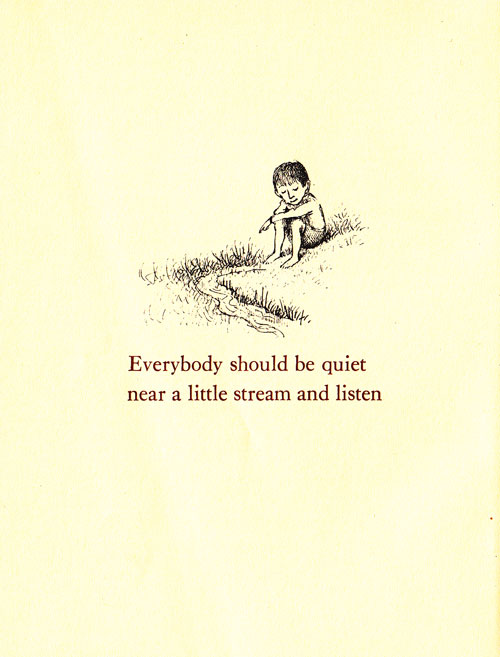 |
| Illustration by Maurice Sendak from 'Open House for Butterflies' by Ruth Krauss. |
We can think of boredom as a defense against waiting, which is, at one remove, an acknowledgement of the possibility of desire… In boredom, we can also say, there are two assumptions, two impossible options: there is something I desire, and there is nothing I desire. But which of the two assumptions, or beliefs, is disavowed is always ambiguous, and this ambiguity accounts, I think, for the curious paralysis of boredom… In boredom there is the lure of a possible object of desire, and the lure of the escape from desire, of its meaninglessness.
[…]
Boredom, I think, protects the individual, makes tolerable for him the impossible experience of waiting for something without knowing what it could be. So that the paradox of the waiting that goes on in boredom is that the individual does not know what he was waiting for until he finds it, and that often he does not know what he is waiting… Clearly, we should speak not of boredom, but of boredoms, because the notion itself includes a multiplicity of moods and feelings that resist analysis; and this, we can say, is integral to the function of boredom as a kind of blank condensation of psychic life.
Adam Phillips
This is the cultural pathology of our time: If we stopped doing what we do, we might not know who we are.
Article by: Maria Popova
Entire article - Brain Pickings:
martes
How to learn: Lewis Carroll's Rules
 |
| Lewis Carroll Writing |
The Learner, who wishes to try the question fairly, whether this little book does, or does not, supply the materials for a most interesting mental recreation, is earnestly advised to adopt the following Rules:
- Begin at the beginning, and do not allow yourself to gratify a mere idle curiosity by dipping into the book, here and there. This would very likely lead to your throwing it aside, with the remark “This is much too hard for me!, and thus losing the chance of adding a very large item to your stock of mental delights. This Rule (of not dipping) is very desirable with other kinds of books—-such as novels, for instance, where you may easily spoil much of the enjoyment you would otherwise get from the story, by dipping into it further on, so that what the author meant to be a pleasant surprise comes to you as a matter of course. Some people, I know, make a practice of looking into Vol. III first, just to see how the story ends: and perhaps it is as well just to know that all ends happily—that the much-persecuted lovers do marry after all, that he is proved to be quite innocent of the murder, that the wicked cousin is completely foiled in his plot and gets the punishment he deserves, and that the rich uncle in India (Qu. Why in India? Ans. Because, somehow, uncles never can get rich anywhere else) dies at exactly the right moment—-before taking the trouble to read Vol. I.
- Don’t begin any fresh Chapter, or Section, until you are certain that you thoroughly understand the whole book up to that point, and that you have worked, correctly, most if not all of the examples which have been set. So long as you are conscious that all the land you have passed through is absolutely conquered, and that you are leaving no unsolved difficulties behind you, which will be sure to turn up again later on, your triumphal progress will be easy and delightful. Otherwise, you will find your state of puzzlement get worse and worse as you proceed, till you give up the whole thing in utter disgust.
- When you come to any passage you don’t understand, read it again: if you still don’t understand it, read it again: if you fail, even after three readings, very likely your brain is getting a little tired. In that case, put the book away, and take to other occupations, and next day, when you come to it fresh, you will very likely find that it is quite easy.
- If possible, find some genial friend, who will read the book along with you, and will talk over the difficulties with you. Talking is a wonderful smoother-over of difficulties. When I come upon anything—in Logic or in any other hard subject—that entirely puzzles me, I find it a capital plan to talk it over, aloud, even when I am all alone. One can explain things so clearly to one’s self! And then, you know, one is so patient with one’s self: one never gets irritated at one’s own stupidity!
If, dear Reader, you will faithfully observe these Rules, and so give my little book a really fair trail, I promise you, most confidently, that you will find Symbolic Logic to be one of the most, if not the most, fascinating of mental recreations!
[…]
Mental recreation is a thing that we all of us need for our mental health; and you may get much healthy enjoyment, no doubt, from Games… But, after all, when you have made yourself a first-rate player at any one of these Games, you have nothing real to show for it, as a result! You enjoyed the Game, and the victory, no doubt, at the time: but you have no result that you can treasure up and get real good out of. And, all the while, you have been leaving unexplored a perfect mine of wealth. Once master the machinery of Symbolic Logic, and you have a mental occupation always at hand, of absorbing interest, and one that will be of real use to you in any subject you may take up. It will give you clearness of thought—the ability to see your way through a puzzle—the habit of arranging your ideas in an orderly and get-at-able form—and, more valuable than all, the power to detect fallacies, and to tear to pieces the flimsy illogical arguments, which you will so continually encounter in books, in newspapers, in speeches, and even in sermons, and which so easily delude those who have never taken the trouble to master this fascinating Art. Try it. That is all I ask of you!
lunes
blanca
tu olor
el roce de las olas contra la roca
tu mirada, blanca, nítida.
la brisa.
la tierra firme bajo mis pies.
y yo, blanca, desdibujada,
que pertenezco a ningún lugar
 |
| josi faye |
Suscribirse a:
Entradas (Atom)