esto va de beber café, escribir surrealismo, hablar francés, mirar el infinito, pensar en pensar en pensar que pienso y volver a beber café, oscuro. brumoso.

Mostrando entradas con la etiqueta CREA-tividad. Mostrar todas las entradas

martes

no-poesía


thy tran


"El único secreto para escribir buena poesía, además de leerla, es tener una relación de intimidad con el mundo".


"Parece que solo se puede ser una cosa. A mí me interesa la poesía de los pintores. Cuando hay una invasión de género, me parece que la creación se enriquece. Por eso me interesa la literatura que no está ni en un sitio ni en otro".


Carlos Pardo
Artículo: Aborrezco el mundo de la poesía

deep reading


Nirav Patel


The difference between deep and light reading


Recent research also revealed that “deep reading”—defined as reading that is slow, immersive, rich in sensory detail and emotional and moral complexity—is distinctive from light reading—little more than the decoding of words. Deep reading occurs when the language is rich in detail, allusion, and metaphor, and taps into the same brain regions that would activate if the reader were experiencing the event. Deep reading is great exercise for the brain, and has been shown to increase empathy, as the reader dives deeper and adds reflection, analysis, and personal subtext to what is being read. It also offers writers a way to appreciate all the qualities that make novels fascinating and meaningful—and to tap into his ability to write on a deeper level.


Light reading is equated to what one might read in online blogs, or “headline news” or “entertainment news” websites, particularly those that breezily rely on lists or punchy headlines, and even occasionally use emojis to communicate. These types of light reading lack a genuine voice, a viewpoint, or the sort of analyses that might stimulate thought. It’s light and breezy reading that you can skim through and will likely forget within minutes.


Article

lunes

para hacer, hacer

1_Las ganas de escribir vienen escribiendo. Es inútil esperar el instante perfecto en que todos  los problemas han desaparecido y solo existe el deseo compulsivo de escribir: ese instante no existe. En general, uno se sienta a escribir venciendo cierta resistencia —salir del estado de ocio no es natural—, uno oficia ciertos ritos dilatorios, uno por fin, con cierta cautela, escribe. Y en algún momento uno tal vez descubre que está sumergido hasta los pelos, que todos  los problemas han desaparecido, y que no existe otra cosa que el deseo compulsivo de escribir.


2_La primera versión de un texto es sólo un mal necesario. Suele estar bien lejos de aquello completo e intenso que uno difusamente ha concebido. Corregir no es otra cosa que ir encontrando a Moisés dentro del bloque de mármol.


3_Ni la espontaneidad ni la velocidad son valores en literatura. Tantear, tachar, descubrir nuevas posibilidades, equivocarse tantas veces como haga falta, ir acercándose paso a paso al texto buscado: ese es el verdadero acto creador. Lo otro es como estornudar.


4_No hay que empezar un cuento si no se sabe cómo va a terminar. Se corre el riesgo de ir de acá para allá, sin ton ni son, esperando que el final caiga del cielo. Los buenos finales no suelen tener origen celestial: aunque no se lo note, vienenmandados desde la primera frase.


5_La inspiración no existe; en eso se parece a las brujas. Entonces, cuando las palabras parecen cantarle a uno  en la oreja, y siente que todo lo que está escribiendo tiene la música justa, el ritmo exacto, la tensión precisa que debe tener, uno puede llamar a ese estado de privilegio como más le guste, pero lo mejor es que suelte el freno y deje rodar la locura. Es hermoso, solo que no hay que creer que es el único estado en que se hace literatura. Porque se corre el riesgo de no escribir más que una página en toda la vida.


6_Hay que nutrirse de los credos y hay que aprender a dudar de ellos. No existen reglas universales para el oficio de escribir. Es uno mismo que a la larga, con verdades y mentiras propias y ajenas,  va estableciendo sus propios ritos, va permitiéndose sus propias manías, va construyendo su propio credo.

Artículo entero: Los diez mandamientos de la escritura

crea(c)tion


"Our goals can only be reached through a vehicle of a plan, in which we must fervently believe, and upon which we must vigorously act. There is no other route to success."
Pablo Picasso

Daily Routines of Creative Minds


boredom and creativity


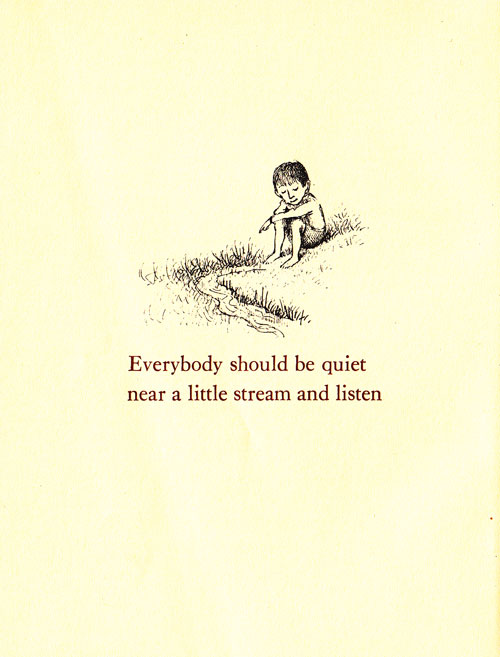
Illustration by Maurice Sendak from
 'Open House for Butterflies' by Ruth Krauss.


We can think of boredom as a defense against waiting, which is, at one remove, an acknowledgement of the possibility of desire… In boredom, we can also say, there are two assumptions, two impossible options: there is something I desire, and there is nothing I desire. But which of the two assumptions, or beliefs, is disavowed is always ambiguous, and this ambiguity accounts, I think, for the curious paralysis of boredom… In boredom there is the lure of a possible object of desire, and the lure of the escape from desire, of its meaninglessness.
[…]
Boredom, I think, protects the individual, makes tolerable for him the impossible experience of waiting for something without knowing what it could be. So that the paradox of the waiting that goes on in boredom is that the individual does not know what he was waiting for until he finds it, and that often he does not know what he is waiting… Clearly, we should speak not of boredom, but of boredoms, because the notion itself includes a multiplicity of moods and feelings that resist analysis; and this, we can say, is integral to the function of boredom as a kind of blank condensation of psychic life.
Adam Phillips

This is the cultural pathology of our time: If we stopped doing what we do, we might not know who we are.
Article by: Maria Popova


Entire article - Brain Pickings

domingo

When you can’t create you can work.


Henry Miller (1891-1980). American writer.


In 1932-1933, while working on what would become his first published novel, Tropic of Cancer, Miller devised and adhered to a stringent daily routine to propel his writing. Among it was this list of eleven commandments, found in Henry Miller on Writing — a fine addition to these 9 essential books on reading and writing, part of this year’s resolution to read more and write better.


COMMANDMENTS


Work on one thing at a time until finished.
Start no more new books, add no more new material to ‘Black Spring.’
Don’t be nervous. Work calmly, joyously, recklessly on whatever is in hand.
Work according to Program and not according to mood. Stop at the appointed time!
When you can’t create you can work.
Cement a little every day, rather than add new fertilizers.
Keep human! See people, go places, drink if you feel like it.
Don’t be a draught-horse! Work with pleasure only.
Discard the Program when you feel like it—but go back to it next day. Concentrate. Narrow down. Exclude.
Forget the books you want to write. Think only of the book you are writing.
Write first and always. Painting, music, friends, cinema, all these come afterwards.


Under a part titled Daily Program, his routine also featured the following wonderful blueprint for productivity, inspiration, and mental health:
If groggy, type notes and allocate, as stimulus.


DAILY PROGRAM


MORNINGS:

If in fine fettle, write.


AFTERNOONS:

Work of section in hand, following plan of section scrupulously. No intrusions, no diversions. Write to finish one section at a time, for good and all.


EVENINGS:

See friends. Read in cafés.

Explore unfamiliar sections — on foot if wet, on bicycle if dry.

Write, if in mood, but only on Minor program.

Paint if empty or tired.

Make Notes. Make Charts, Plans. Make corrections of MS.

Note: Allow sufficient time during daylight to make an occasional visit to museums or an occasional sketch or an occasional bike ride. Sketch in cafés and trains and streets. Cut the movies! Library for references once a week.


jueves

Crear


“No se trata de no sentir miedo, sino de actuar a pesar de él”
José Antonio Marina


Artículo: 


Bibliografía:

“El arte de no amargarse la vida” Santandreu, R. (2011), Barcelona, ePub.
“El arte y la creación de la mente” Eisner, E.W. (2011), Barcelona, Paidós
“Los miedos y el aprendizaje de la valentía” Marina, J.A. (2014), Barcelona, Ariel

miércoles

que la literatura nos rescate

Me interesa leer sobre creatividad. Literatura, arte... y hoy me he encontrado con este artículo que me ha hecho pensar en el proceso de leer y observar y pintar pinturas para formarse.
Y en mi hermano pequeño que hace poco ha descubierto los libros de fantasía... me recuerda a mi de pequeña, siempre enfrascada en alguna lectura.
¿Cómo promoverla? Si a veces lucho conmigo misma para encauzarla y recuperarla.
Pero me recuerda que es importante y la pasión con la que emprendo un libro interesante.
Allá voy.


rescatar la literatura

viernes


Fragmento que encontré en la lectura del libro 
de Albert Esteve de Quesada, "Creación y proyecto".